What Is E-Commerce Marketing? Complete Beginner Guide 2026
Introduction
If you are a beginner and wondering what is e-commerce marketing, this complete guide will help you understand it in simple language. E-commerce has changed the way people discover, compare, and purchase products. Today, customers can find products through Google, social media, online advertisements, websites, emails, and other digital channels.
But creating an online store is only the first step. Businesses also need to attract the right audience and give customers a reason to choose their products. This is where e-commerce marketing becomes important.
In this guide, we will cover the e-commerce marketing definition, an introduction to e-commerce marketing, its major strategies, benefits, examples, and beginner-friendly tips for growing an online business in 2026.
The basic purpose of on-page SEO is to structure content so that both users and search engines can understand and value it. The uploaded SEO guide also recommends starting with keyword research and then optimizing the title, URL, meta description, headings, images, links, readability, and mobile experience.
Summary
E-commerce marketing is the process of promoting an online store, products, or services through digital marketing channels. Its goal is to attract potential customers, generate website traffic, increase conversions, and build long-term customer relationships.
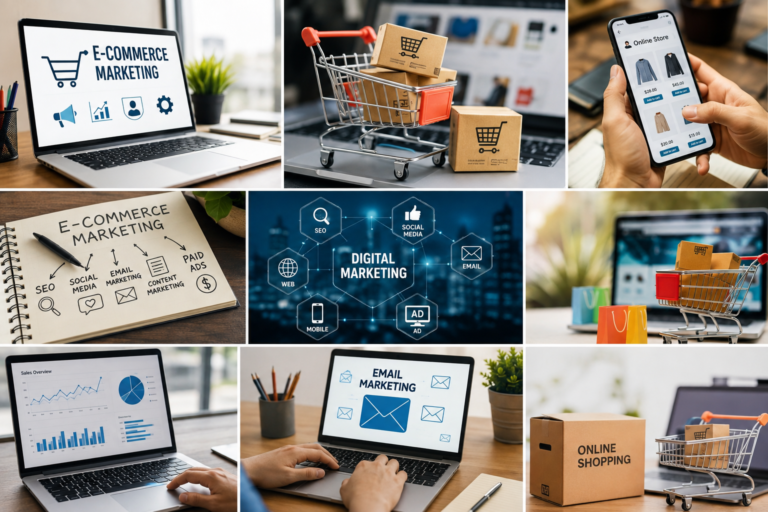
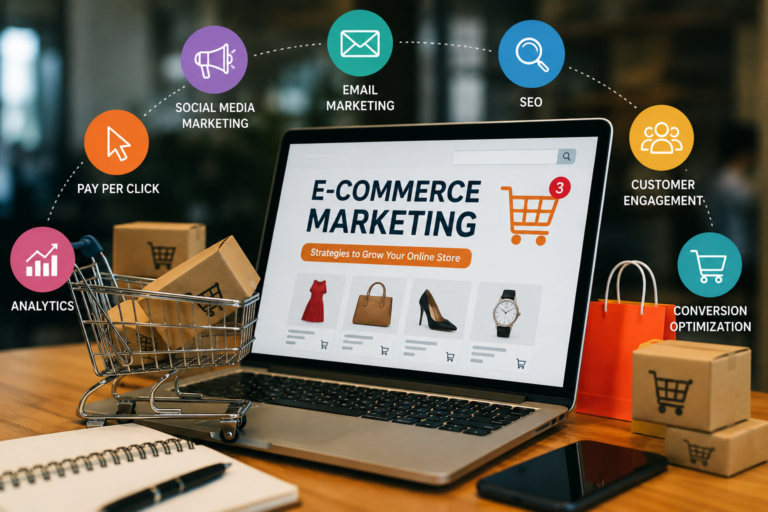
The major areas of e-commerce marketing include:
Search Engine Optimization (SEO)
Social Media Marketing
Paid Advertising
Content Marketing
Email Marketing
Influencer Marketing
Remarketing
Customer Reviews
Mobile and website optimization
A successful strategy does not depend on only one channel. Instead, businesses can combine different methods according to their audience, products, budget, and goals.
What Is E-Commerce Marketing?
The simple answer to what is e-commerce marketing is that it means using online marketing methods to promote and sell products or services through an e-commerce business.
For example, imagine you have an online clothing store. You can use SEO to appear in Google search results, Instagram to showcase your products, Google Ads to reach people searching for specific products, and email marketing to stay connected with previous customers.
All these activities are part of e-commerce marketing.
E-Commerce Marketing Definition
The e-commerce marketing definition can be explained as:
E-commerce marketing is the use of digital channels and marketing strategies to attract customers, promote products, increase online sales, and retain existing customers.
It covers the complete customer journey, from discovering a brand to purchasing a product and potentially becoming a repeat customer.
Introduction to E-Commerce Marketing
A simple introduction to e-commerce marketing begins with understanding how customers make online purchasing decisions.
A customer might first see a product on social media. They may then search for the product on Google, visit an online store, compare prices, read reviews, and finally make a purchase.
E-commerce marketing helps businesses connect with customers at each stage.
The basic customer journey can be divided into:
Awareness – The customer discovers your brand.
Interest – The customer becomes interested in your product.
Consideration – The customer compares options.
Purchase – The customer buys the product.
Retention – The business encourages future purchases.
Understanding this journey helps businesses create the right content and marketing message for each stage.
Why Is E-Commerce Marketing Important?
E-commerce competition is increasing. Customers have many choices, so businesses need to make their products visible and trustworthy.
1. Reaches More Customers
Digital marketing allows an online store to reach customers beyond its local area. A business can potentially target audiences across different cities, regions, or countries.
2. Builds Brand Awareness
Regular content, SEO, advertisements, and social media activity can help people recognize a brand.
3. Increases Website Traffic
SEO, social media, paid advertising, and useful content can bring relevant visitors to an online store.
4. Helps Increase Sales
When the right audience reaches an optimized product page, the chances of conversion can improve.
5. Builds Customer Relationships
Email marketing, customer support, social media, and loyalty activities can help businesses maintain relationships with customers.
Main E-Commerce Marketing Strategies
1. E-Commerce SEO
SEO is one of the most important long-term strategies for an online store. It helps product pages, category pages, and useful content appear in search results.
The first step is keyword research. Businesses should understand what their customers search for and select relevant keywords with suitable search volume and competition.
For example, instead of targeting only “shoes,” an online store might create content around a more specific search such as “best running shoes for beginners.”
E-commerce SEO can include:
Keyword research
Product page optimization
Category page optimization
SEO titles
Meta descriptions
Clean URLs
Image ALT text
Internal linking
Technical SEO
Helpful blog content
The focus keyword should appear naturally in important areas such as the title, URL, meta description, first part of the content, headings, and image ALT text. However, excessive repetition should be avoided.
2. Product Page Optimization
Product pages are important because they can directly influence purchasing decisions.
A good product page should include:
Clear product title
High-quality images
Useful description
Product features
Benefits
Price
Customer reviews
Delivery information
Return policy
Clear CTA
Product descriptions should be written for customers first. They should explain what the product does, who it is for, and why someone might choose it.
3. Social Media Marketing
Social media gives e-commerce businesses a way to display products and communicate with potential customers.
Businesses can use platforms such as Instagram, Facebook, YouTube, and Pinterest to share:
Product photos
Reels
Tutorials
Product demonstrations
Customer reviews
Offers
Educational posts
For example, a fashion brand can create short videos showing different ways to style the same product.
The goal should not be to post advertisements all the time. Useful, entertaining, and educational content can create stronger audience engagement.
4. Paid Advertising
Paid advertising can provide faster visibility for an online store.
Businesses can use search advertising and social media advertising to reach specific audiences. For example, an electronics store can advertise a new smartphone to people searching for relevant products or showing interest in mobile technology.
Important advertising metrics include:
Click-through rate
Conversion rate
Cost per click
Cost per acquisition
Return on ad spend
Testing different creatives, audiences, headlines, and landing pages can help identify better-performing campaigns.
5. Content Marketing
Content marketing attracts potential customers by providing useful information.
An e-commerce business can create:
Buying guides
Product comparisons
How-to articles
Tutorials
FAQs
Videos
Blog posts
Social media content
For example, a laptop store can publish a beginner-friendly guide explaining how students can choose a laptop.
Useful content can attract people before they are ready to purchase and help establish the brand as a helpful source of information.
The SEO guide recommends short paragraphs, simple language, short sentences, active voice, and transition words to improve readability.
6. Email Marketing
Email marketing helps e-commerce businesses communicate with customers after and before a purchase.
Common e-commerce emails include:
Welcome emails
New product announcements
Special offers
Festival promotions
Product recommendations
Abandoned-cart reminders
Feedback requests
The most effective approach is to send relevant messages rather than sending identical promotions to every subscriber.
7. Influencer Marketing
Influencer marketing involves collaborating with creators who have an audience relevant to a product.
For example, a fitness brand can work with a fitness creator to demonstrate its products.
Businesses should consider audience relevance, engagement, content quality, and trust rather than choosing an influencer only because they have a large follower count.
8. Remarketing
Not every website visitor purchases immediately. Some visitors compare products or plan to return later.
Remarketing allows businesses to reconnect with people who previously interacted with their website or products, subject to applicable advertising and privacy requirements.
For example, someone who viewed a product may later see a relevant advertisement reminding them about that product.
9. Customer Reviews and Trust
Trust plays a major role in online shopping because customers cannot physically examine products before buying.
Genuine reviews, accurate descriptions, clear return policies, secure payment options, and useful product information can help customers feel more confident.
Businesses should also respond professionally to customer questions and complaints.
10. Mobile and Website Optimization
Many customers browse and shop using smartphones. Therefore, an e-commerce website should provide a smooth mobile experience.
Important areas include:
Fast loading pages
Mobile-friendly design
Simple navigation
Easy checkout
Compressed images
Clear buttons
Easy-to-read content
The SEO guide also highlights mobile responsiveness and fast loading as important parts of a well-optimized website.
How Beginners Can Start E-Commerce Marketing in 2026
If you are new to e-commerce marketing, do not try to learn every strategy at once.
Start with these steps:
Step 1: Understand Your Audience
Identify who your customers are, what they need, and what problems your product solves.
Step 2: Research Keywords
Find relevant search terms that your target customers use.
Step 3: Optimize Your Website
Create clear product pages, optimized titles, descriptions, URLs, headings, and images.
Step 4: Start Content Creation
Create helpful blogs, videos, social media posts, and product guides.
Step 5: Promote Your Products
Use suitable channels such as SEO, social media, email, and paid advertising.
Step 6: Measure Results
Track traffic, engagement, conversions, sales, and other relevant metrics.
Step 7: Improve Continuously
Keep testing different strategies and improve your marketing based on the results.
Common E-Commerce Marketing Mistakes
Beginners should avoid these common mistakes:
Keyword stuffing
Ignoring mobile users
Using poor-quality product images
Writing unclear product descriptions
Focusing only on traffic
Ignoring customer reviews
Not measuring marketing results
Making checkout complicated
Creating content only for search engines
The SEO framework recommends using one focus keyword per blog and keeping keyword placement natural rather than forcing the keyword repeatedly.
Conclusion
Now you know what is e-commerce marketing and why it is important for online businesses in 2026.
E-commerce marketing is not simply about selling products online. It is about attracting the right audience, providing useful information, building trust, creating a smooth shopping experience, and encouraging customers to return.
SEO can help bring organic traffic. Social media can build engagement. Paid advertising can provide faster visibility. Content marketing can educate customers, while email marketing and remarketing can help maintain customer relationships.
For beginners, the best approach is to start with the basics and improve step by step. Research your audience, choose relevant keywords, optimize your website, create useful content, promote your products, and measure your results.
The goal of on-page SEO is simple: write for people and structure the content so search engines can understand it.
Call to Action – Learn Digital Marketing with Vidya Sarthi
Want to learn e-commerce marketing and digital marketing practically?
Vidya Sarthi can help you build your digital marketing knowledge and understand important areas such as SEO, social media marketing, paid advertising, content marketing, and other digital marketing skills.
Whether you are a beginner planning your career or want to develop practical digital marketing skills, start learning today with Vidya Sarthi and take the next step toward your digital marketing journey.
 Join Vidya Sarthi and start building your digital marketing skills today!