Introduction
Artificial Intelligence (AI) is becoming an important part of digital marketing. Earlier, marketers had to spend a lot of time researching customers, creating content, checking campaign performance, and managing advertisements manually. Today, AI tools can help marketers complete many of these tasks faster and more efficiently.
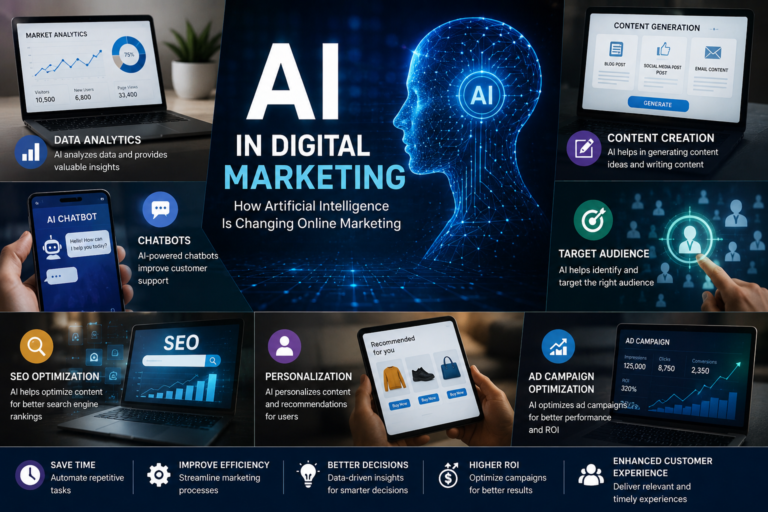
AI in digital marketing means using intelligent technologies to understand customer behaviour, create and personalize content, analyze data, improve advertising, and automate repetitive tasks. From chatbots and recommendation systems to AI-powered content creation and advertising platforms, businesses are using AI in many different ways.
The growth of AI does not mean that human marketers are no longer important. Instead, AI works as a supporting tool that helps marketers save time and make better decisions. When AI and human creativity are used together, digital marketing can become more effective.
Summary
AI is changing digital marketing by making marketing activities faster, smarter, and more personalized. It can analyze large amounts of customer data, identify trends, suggest content ideas, automate repetitive work, and help businesses understand what their customers want.
Some major applications of AI in digital marketing include content creation, SEO, social media marketing, email marketing, chatbots, customer segmentation, and paid advertising. AI can also help marketers predict customer behaviour and improve campaigns based on performance data.
However, marketers should not depend completely on AI. AI-generated information can sometimes be inaccurate or too generic. Human creativity, fact-checking, strategy, and emotional understanding are still necessary for successful marketing.
1. AI-Powered Content Creation
Content is one of the most important parts of digital marketing. Businesses need blogs, social media posts, email campaigns, product descriptions, and advertisements regularly.
AI tools can help marketers generate content ideas, create first drafts, write headlines, and improve existing content. This can save a lot of time, especially when marketers have to create content for multiple platforms.
For example, a digital marketer can use AI to generate several ideas for an Instagram campaign and then edit the best idea according to the brand’s tone and audience.
AI should be treated as a content assistant rather than a complete replacement for human creativity. Human editing is important to make content natural, useful, accurate, and relevant.
2. AI and SEO
Search Engine Optimization (SEO) is another area where AI is becoming useful. SEO involves improving a website so that it can appear more prominently in search results.
AI can help marketers with keyword research, content ideas, search intent analysis, competitor research, and content optimization. It can also help identify questions that users are searching for.
For example, if a business wants to create a blog about digital marketing, AI can suggest related topics and questions that potential customers may be interested in. The marketer can then create useful content based on real audience needs.
However, simply using AI-generated content does not guarantee better search rankings. The content should provide genuine value, be accurate, original, and satisfy the user’s search intent.
3. Personalized Marketing
Customers do not always want to see the same message. They are more likely to respond when content is relevant to their interests.
AI can analyze customer interactions and preferences to help businesses provide more personalized experiences. For example, an e-commerce website may recommend products based on a customer’s previous browsing or purchasing behaviour.
Email marketing can also benefit from personalization. AI can help marketers decide which type of message may be more relevant to different customer groups.
This makes marketing more customer-focused instead of sending exactly the same communication to everyone.
4. AI in Social Media Marketing
Social media marketers have to manage content planning, posting, audience engagement, and performance analysis. AI can support many of these activities.
AI tools can help generate post ideas, captions, content calendars, and basic creative concepts. They can also help analyze engagement data and identify which types of content are performing well.
For example, if a brand notices that educational short videos are receiving more engagement than regular posts, marketers can use this information to improve their future content strategy.
5. AI Chatbots and Customer Support
AI-powered chatbots are widely used by businesses to communicate with customers. They can answer common questions, provide basic information, and guide users through simple processes.
For example, a customer visiting a website may ask about delivery time, available services, or product information. A chatbot can provide an immediate response instead of making the customer wait for a human representative.
This can improve the customer experience and reduce the workload of support teams. However, complicated or sensitive customer issues should still be handled by trained human employees.
6. AI in Paid Advertising
Paid advertising platforms use AI and machine learning to optimize campaigns. AI can analyze data such as clicks, conversions, audience behaviour, and engagement.
Digital marketers can use these insights to understand which advertisements are performing better and where improvements may be needed.
AI can also assist with audience targeting, budget optimization, and testing different versions of advertisements. This helps marketers make data-driven decisions instead of relying only on assumptions.
7. Predictive Analytics
One of the powerful uses of AI is predictive analytics. It involves analyzing existing data to identify possible future trends or customer behaviour.
For example, a business can analyze previous sales and customer activity to understand which products may receive higher demand in the future.
This can help businesses plan their marketing campaigns, budgets, and promotional activities more effectively.
8. Benefits and Challenges of AI in Digital Marketing
AI offers several benefits to digital marketers. It can save time, reduce repetitive work, analyze large amounts of data, improve personalization, and support faster decision-making.
At the same time, there are challenges. AI-generated content may contain mistakes, lack originality, or sound repetitive if it is not properly edited. There are also concerns related to privacy, data usage, and responsible use of AI.
Therefore, marketers should use AI carefully and ethically. Human judgment should remain an important part of the marketing process.
Conclusion
AI is transforming digital marketing by helping businesses understand customers, create content, analyze data, automate tasks, and improve marketing campaigns. It is making many marketing processes faster and more efficient.
However, AI is not a complete replacement for digital marketers. Creativity, strategy, communication skills, critical thinking, and understanding customer emotions are still important.
The future of digital marketing will likely involve a combination of AI technology and human creativity. Marketers who learn how to use AI effectively while maintaining originality and quality can gain a strong advantage in the changing digital landscape.
Call to Action
AI is already becoming a valuable skill for digital marketers. Start learning AI tools today and explore how they can improve your SEO, social media, content marketing, email marketing, and advertising skills.
join vidya sarthi
Don’t just use AI to save time—learn how to use it smartly to become a better digital marketer.